
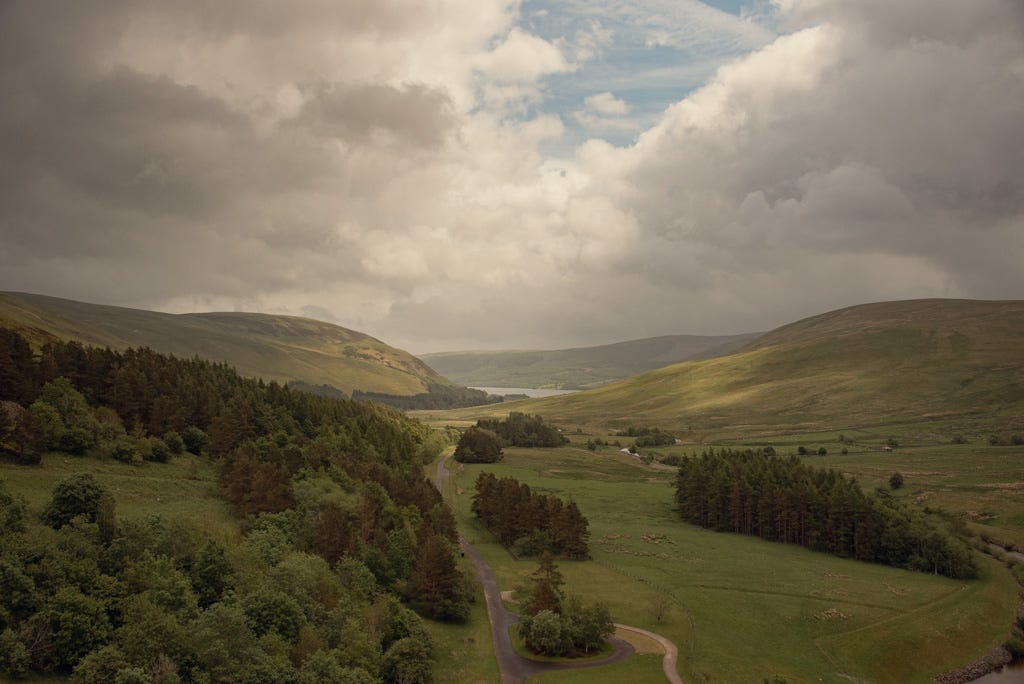
If you walk far enough up the valley, past St Mary’s Loch and on toward the head of the Yarrow, you reach a stretch of country where the hills crowd close to the water and the wooded glens fall steep and dark. The old Scots word for these narrow wooded valleys is dens. And dowie, a word you don’t hear much any more, means dismal, sorrowful, mournful.
The dowie dens of Yarrow. The sorrowful, narrow valleys of this river. The phrase comes from one of the great Border ballads, a song so old that nobody quite knows where it began. Sung by shepherds and travelling folk for at least four hundred years, and probably longer.
The story is brutal and short. A young knight rides out into the Yarrow valley to meet, by some accounts, his lover’s nine brothers, or her father, or a rival suitor backed by armed men. The numbers vary; the outcome doesn’t. He fights them all, kills most of them, and is killed himself, treacherously, by the last one standing. His lover, warned in a dream that something has gone wrong, runs down the hill, finds him among the bodies on the riverbank, and weeps over him. Her father tells her not to grieve, he’ll find her a better husband. She refuses. In some versions she dies of sorrow on the spot.
Sir Walter Scott, who collected the ballad for his Minstrelsy of the Scottish Border in 1803, believed it was based on a real event, a duel between two members of the Scott clan, possibly John Scott of Tushielaw or one of the sons of the Laird of Harden, killed somewhere on this stretch of the Yarrow in the late 1500s.
Modern scholars are less certain. A near-identical ballad exists in Scandinavia, called Herr Helmer, which suggests the story may be older and more universal than any single Border feud. But whether or not the duel actually happened, the song has been sung in these valleys for so long that it has become part of the landscape — the kind of folk memory that, as one writer put it, is older than any of the families who claim to remember it.
She kiss’d his cheek, she kaim’d his hair, / She search’d his wounds all thorough; / She kiss’d them, till her lips grew red, / On the dowie houms of Yarrow.
Houms is another word lost from English, the flat low ground beside a river. The ballad is full of these words, words that only survive now in the songs that carry them. Which is, perhaps, the truer reason to keep singing them.
What’s most remarkable about the song is its rhyme scheme. Out of fifteen verses, fourteen end on the word Yarrow, or words that rhyme with it: sorrow, morrow, marrow, narrow, arrow. The whole song is held in place by the name of this one river, repeated until the river itself feels like a character. James Hogg, the Ettrick Shepherd, who grew up a few miles from where these events allegedly took place, said he had heard a version as a boy that no two singers in the valley sang the same way. Every shepherd had his own verses. Every singer added something. By the time Scott wrote it down, what he was collecting was less a poem than a living thing.
If you’d like to hear the ballad sung, look for the recording by Karine Polwart, below, or the older version by Davy Stewart collected by Hamish Henderson in the 1950s. Both are quietly devastating. Both are best listened to in the gloaming, with a window open onto the valley they describe.
The Scullery sits a few miles downstream from the deepest of those dens. The Yarrow Water runs at the foot of our garden. If you stay, and if you walk up the valley one evening, particularly in autumn, when the light turns copper and the wind drops, you may understand exactly why this song refuses to die.
From The Scullery
Letters from the Scullery is a bi-monthly publication from The Scullery at Ladhope Farmhouse, a boutique one-bedroom cottage in the Yarrow Valley, Scottish Borders. Join the Inner Circle at the-scullery.com for early access to dates and Inner Circle rates on midweek stays.