
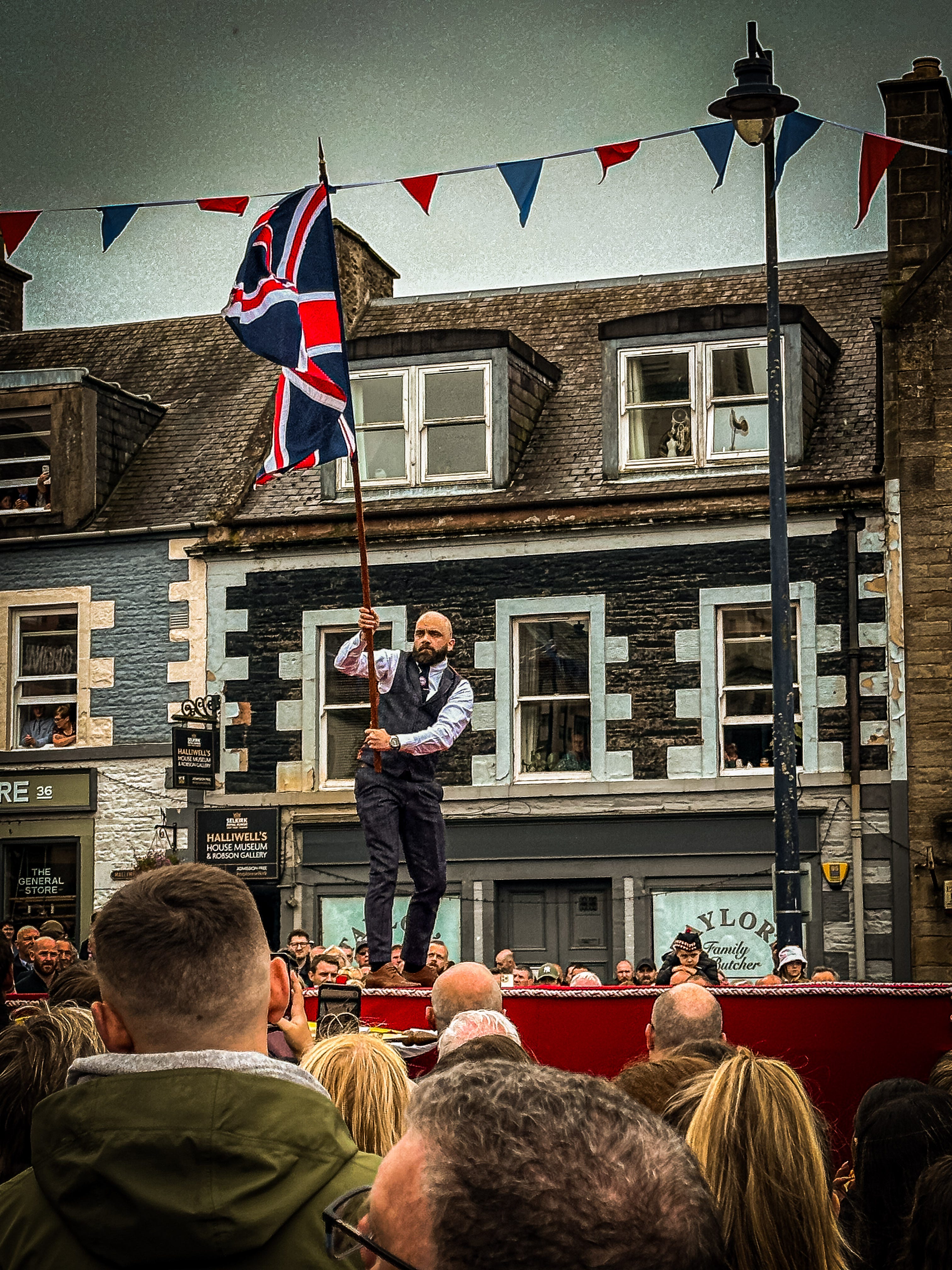
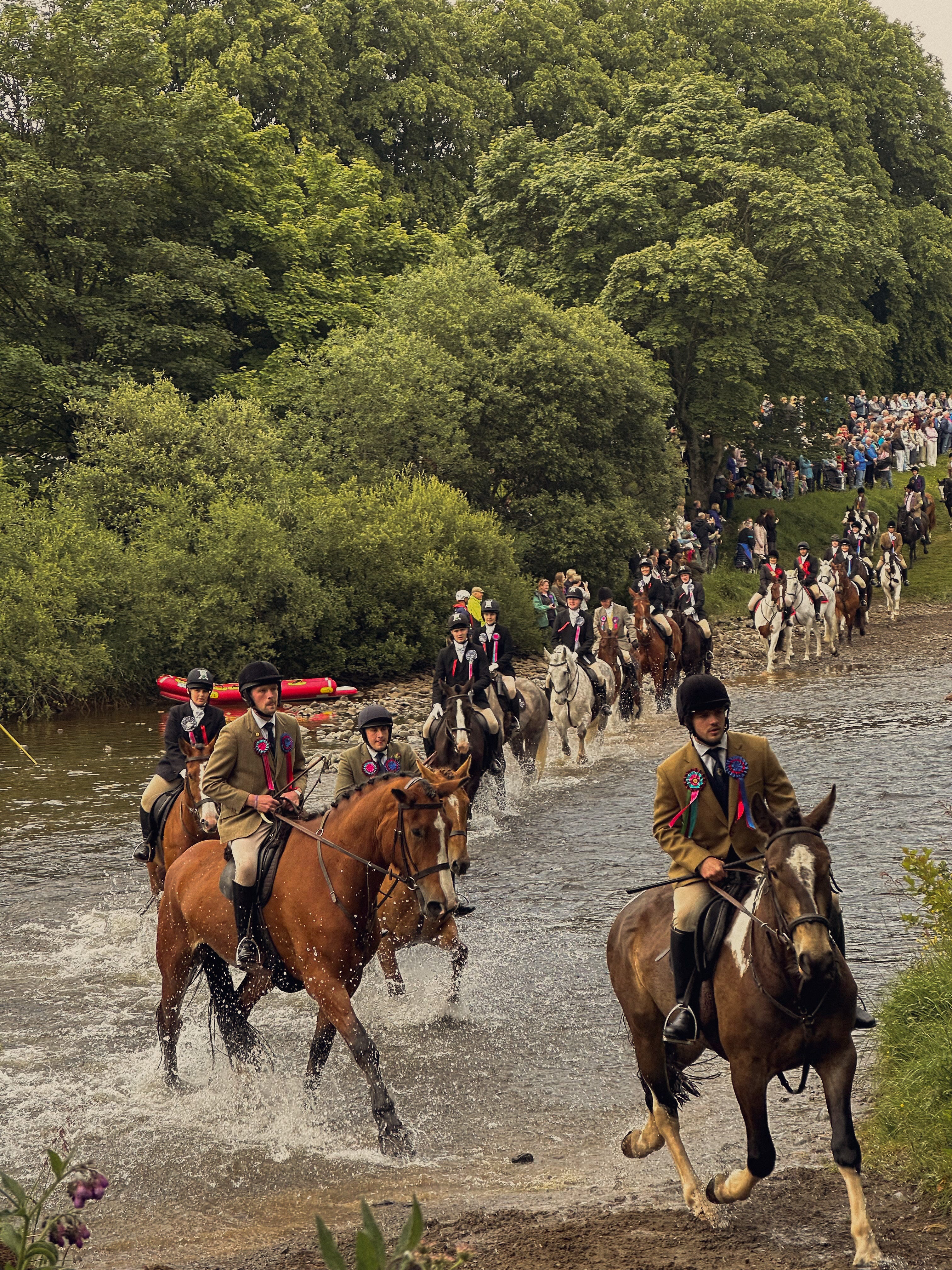
On the second Friday after the first Monday in June — the Borders keeps its dates by old and complicated reckonings — the town of Selkirk wakes before dawn to the sound of a flute band playing through the streets. By six in the morning several hundred riders are mounted in the Marketplace. By the time the sun is properly up they have ridden out to the boundaries of the common land, the burgh’s ancient marches, and returned. And then, in front of a silent crowd of thousands, the standard-bearers cast their flags — a slow, ceremonial furling and unfurling of the burgh colours, each man alone in the middle of the square. It is one of the most moving things you will see in Scotland, and almost nobody outside the Borders knows it happens.
The Common Ridings have their roots in the practical business of the Middle Ages. A burgh held common land, and once a year its men rode the boundaries to check that no neighbour had moved a march stone or encroached on the common. In the Borders, where the line between Scotland and England was for centuries a place of raid and reive and burning, this was not a quiet administrative task. It was done on horseback, in numbers, armed. The riding of the marches was an assertion: this is ours, we know its edges, and we will defend them.
Selkirk’s riding carries something else as well, something darker and older. The town’s particular grief is Flodden — the battle of 9 September 1513, where James IV and the flower of Scottish nobility were destroyed by an English army, and where, the tradition holds, eighty men of Selkirk marched out and one came back. His name was Fletcher, and he returned carrying a captured English flag, too broken by what he had seen to speak. Unable to tell the waiting townsfolk how complete the disaster had been, he cast the flag around his head and dashed it to the ground — a gesture that said, without words, that all the rest were dead.
“And one came back, carrying a captured flag, too broken to speak.”
Whether the story is literally true matters less than what the town has made of it. Every year the casting of the colours re-enacts that moment. The Royal Burgh Standard Bearer — the Cornet, a young man of the town chosen for the honour — casts the Burgh flag, and then the standard-bearers of the trades and the associated bodies cast theirs in turn, each one a feat of strength and grace, the heavy silk flags swept in great circles around their heads while the crowd holds its breath. A lament is played. The names of Flodden are remembered. Grown men weep, openly, in the Marketplace, and nobody thinks it strange.
What strikes the outsider is how unselfconscious it is. This is not a heritage performance for visitors. There are visitors, and they are welcome, but the riding is not for them. It is the town speaking to itself, across five hundred years, about loss and belonging and the land under its feet. The young men who ride did so as boys, watching their fathers; they will watch their own sons ride in turn. The continuity is the point.
Selkirk’s is the largest mounted gathering in the Borders, and arguably in Europe — some years more than four hundred horses ride out. But every Border town has its version: Hawick in early June, with its cry of “Teribus ye teri odin”; Langholm with its famous Common Riding at the end of July, where emblems of a barley bannock and a salted herring nailed to a board are carried through the town;
Lauder, Jedburgh, Kelso, each with its own day, its own rituals, its own remembered grief or triumph. If you are in the valley across the summer, you will almost certainly hear a flute band at dawn somewhere, or meet a cavalcade of horses on a back road, or find a town dressed in its colours. Stop. Watch. You are seeing something very old, and very alive.
If you’d like to see the Selkirk Common Riding, it falls in mid-June; the associated festivities run for the better part of a fortnight. Hawick, Langholm, and the other ridings are spread across June, July, and August. Ask us and we’ll tell you what’s on when you visit. See you in 2027